
DIY aluminum profile rigs: 8020/4040, T-nuts, and mounting plates
A DIY aluminum profile rig builds from three things: 40-series extrusion, T-nuts, and corner brackets. Get the profile sizing and the hardware count right and you can land a 15-25Nm-capable cockpit for 40-50% less than a commercial frame. Get them wrong and you spend $350 on T-nuts to save $200 on extrusion.
”8020” is a brand, not a size
Section titled “”8020” is a brand, not a size”8020 is a company (8020.net), not a profile dimension, and that trips up almost everyone. People read “8020 rig” and assume it means an 80x20mm bar. It doesn’t.
The sizes you actually order are metric and describe the cross-section in millimeters:
- 4040 = 40x40mm
- 4080 = 40x80mm (sometimes written 8040)
- 40120 = 40x120mm
All three are “40 series,” which means an 8mm slot that takes M8 (and, with the right nut, M6) socket-head or button-head bolts. The 20-series bars you see on 3D printers have a ~5-6mm slot and are too small to build a rig from.
4040 vs 4080: put 4080 where the load is
Section titled “4040 vs 4080: put 4080 where the load is”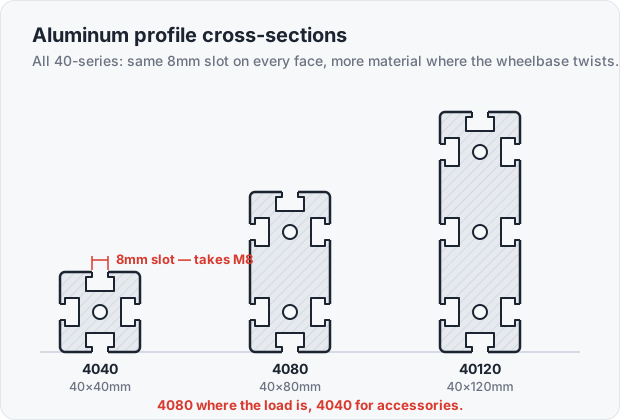
Run 4080 for the main frame and uprights, 4040 for accessories. 4080 doubles the bending stiffness in the direction a wheelbase tries to twist the frame, so it goes where the load is.
- 4080: front wheelbase mount, main floor rails, and any upright carrying a 15-25Nm direct drive (Simagic Alpha, Moza R12/R21, Fanatec ClubSport DD) or a triple-monitor stand.
- 4040: seat brackets, pedal mounts, single-monitor arms, side rails.
A 4080 main frame with 4040 accessories handles a mid-torque base (Moza R9 at 9Nm, Fanatec CSL DD at 8Nm with the boost kit) without a flex you’d notice. For a high-torque DD or triples, put 4080 in the uprights too.
Don’t double up two 4040 bars to fake a 4080. The lateral support splits between two pieces, they flex unevenly, and the joint is the weak point. A single 4080 is stiffer and cheaper than two 4040s plus the hardware to join them.
Fasteners, not extrusion, are where the budget explodes
Section titled “Fasteners, not extrusion, are where the budget explodes”There are two T-nut types and you need to know which before you assemble:
- Slide-in (standard) T-nuts load from the cut end of a bar. Fine while the channel still has an open end.
- Drop-in / roll-in spring T-nuts snap into the channel anywhere along its length; a spring ball holds them in place. You need these the moment both ends of a bar are capped or bracketed and you can’t slide a nut in. (The “EYPINS Roll-in Spring M8 T Nuts for 4040/4080” type is the common one.)
Order a mix, weighted toward roll-in, because you will always find one more accessory to add after the frame is built.
The hardware is where DIY budgets explode. One builder spent $200 on extrusion and $350+ on T-nuts, corner brackets, end caps, and bolts. Another weighed the finished hardware at 13.6kg (30 lb) of nuts and bolts. The fasteners are often the larger line item, not an afterthought.
Buy thick corner brackets; gussets kill frame flex
Section titled “Buy thick corner brackets; gussets kill frame flex”Buy the thick 90-degree corner brackets, not the cheap thin ones. The thin stamped brackets flex under a DD’s torque and let the frame walk. Beyond the corners:
- L-brackets and T-brackets for tying rails to uprights.
- Gusset / 45-degree brackets across corners for cross-bracing. This kills frame flex on a high-torque base more than thicker bars do. See rig stability and cable management for where bracing matters most and how to route cables through the profile channel.
Mount pedals to the extrusion, and keep the seat rails level
Section titled “Mount pedals to the extrusion, and keep the seat rails level”Two choices carry the weight: mount pedals straight to the extrusion (stiffer, and it saves roughly eight brackets) and keep the seat rails level with each other.
- Seat: bolt M8 T-nuts to a pair of level rails, then a car seat on sliders. Keep the slider mounts level with each other: uneven mounts make the seat fight you when it slides.
- Pedals: mount directly to the extrusion where you can. It saves you roughly eight brackets and is stiffer than going through a plate, which matters under a load-cell brake. A heel plate or aluminum mounting plate is the alternative if your pedals need a flat base.
- Wheelbase: a 4080 front upright with a wheelbase mounting plate; use four M8 bolts into roll-in nuts.
- Monitors: a 4040 arm holds a 27” with no sag. Step to 4080 uprights for 32”+ or triples.
3030 profile often shares the same nut size as 4040, so cheap 3030 rigs can sometimes take 4040 accessories, but 4040/4080 is the standard to build around.
Where to buy: the savings come from hardware sourcing, not extrusion
Section titled “Where to buy: the savings come from hardware sourcing, not extrusion”The supplier choice decides whether DIY is cheaper at all:
- US, QA’d, fast: 8020.net, tnutz.com. Cut-to-length, accurate, and priced like a premium.
- EU: Motedis, aluxprofile, dold-mechatronik, treq.
- Cheapest: AliExpress / Alibaba, lowest extrusion and hardware prices, but 1-2 month shipping and tariff risk.
- Semi-DIY: RigMetal (US) sells partial and prebuilt frames if you want to skip the cut list.
Order everything from 8020.net or tnutz at brand prices and the saving evaporates. The 40-50% cut is real only when you buy extrusion from a regional cutter and the T-nuts, brackets, and bolts from AliExpress or a non-brand supplier, and accept the 1-2 month shipping wait on the hardware.
Does DIY save money? Only sometimes
Section titled “Does DIY save money? Only sometimes”A minimal DIY rig sourced entirely from 8020.net runs roughly $450-600, about the price of a commercial entry frame. Compare that to off-the-shelf frames:
- Sim-Lab GT1 Evo (entry, frame only): ~$449
- Sim-Lab GT1 Pro: ~$649
- Trak Racer TR80 Lite: ~$469
So a brand-sourced DIY build in that range costs as much as or more than an entry GT1 Evo or a TR80 Lite, and you still have to design, cut, and assemble it.
When to just buy a commercial rig instead
Section titled “When to just buy a commercial rig instead”If your goal is the lowest price for a known-good frame, buy a commercial rig: a TR80 Lite or a GT1 Evo undercuts a brand-sourced DIY build and arrives with a cut list someone already validated.
DIY wins on fit, not cost. Build it yourself when you need geometry no off-the-shelf rig offers: a frame sized for a tight closet, inverted pedals, a foldable rig on casters that stores in a cupboard, or a wheelbase mount at an angle no manufacturer ships.
Frequently asked questions
Does 8020 mean an 80x20mm profile?
No. 8020 is a company (8020.net), not a dimension. The sizes you order are metric cross-sections: 4040 (40x40mm), 4080/8040 (40x80mm), and 40120 (40x120mm). All three are '40 series', meaning an 8mm slot that takes M8 bolts. The 20-series bars you see on 3D printers have a ~5-6mm slot and are too small to build a rig from.
Should I use 4040 or 4080 profile for a DIY rig?
Run 4080 for the main frame, uprights, wheelbase mount, and triple-monitor stand, because it doubles bending stiffness in the direction a wheelbase tries to twist the frame. Use 4040 for seat brackets, pedal mounts, and single-monitor arms. Don't double up two 4040 bars to fake a 4080: a single 4080 is stiffer and cheaper than two 4040s plus the hardware to join them.
Why did my DIY aluminum rig cost as much as buying one?
The hardware is where DIY budgets explode. One builder spent $200 on extrusion but $350+ on T-nuts, brackets, end caps, and bolts; one finished rig weighed 13.6kg (30 lb) of fasteners. A minimal rig sourced entirely from 8020.net runs roughly $450-600, about the price of an entry commercial frame. The 40-50% saving only materializes when you buy extrusion from a regional cutter and T-nuts/brackets cheap, and accept the shipping wait.
What's the difference between slide-in and roll-in T-nuts?
Slide-in (standard) T-nuts load from the open cut end of a bar. Drop-in/roll-in spring T-nuts snap into the channel anywhere along its length, held by a spring ball. You need roll-in nuts the moment both ends of a bar are capped or bracketed and you can't slide a nut in. Order a mix weighted toward roll-in, because you will always find one more accessory to add after the frame is built.