Brake bias explained: front/rear setup for stability and rotation
Brake bias is the front/rear split of your braking force. At 50% the front and rear brakes share equally; above 50% the fronts work harder, below 50% the rears do. That single number decides whether the car points into the corner under braking or plows straight on, so it matters most on entry, exactly where you trail off the pedal toward the apex. In iRacing the number reads as a front percentage, so higher sends more force forward; a GT3 car starts around 52-56% front and you tune from there.
Higher percent sends more force to the fronts
Section titled “Higher percent sends more force to the fronts”In iRacing’s GT and formula cars the bias is shown as a front percentage. Raise it (54% to 56%) and you send more force forward. Lower it (52% to 50%) and you send more force rearward. Higher percent equals more front; that is the convention to anchor on, and the iRacing wiki lists it the same way across cars.
One thing to check first. A real bias-bar adjuster is counted in turns of a threaded bar, not a front percent, and a few cars expose the number differently from the standard front-percent readout. Confirm which way the number moves before you chase balance; move it the wrong way and a fix becomes a spin.
Bias changes balance, not stopping distance
Section titled “Bias changes balance, not stopping distance”Brake bias changes balance, not straight-line stopping distance. Both axles still do roughly the same total work to stop the car. What you are choosing is which axle runs out of grip first.
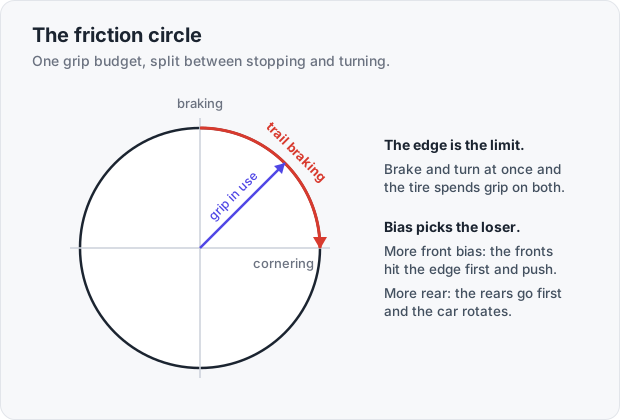
Under braking each tire spends grip on a friction circle: it can only do so much combined longitudinal (stopping) and lateral (turning) work at once. Trail braking trades stopping grip for cornering grip as you ease off the pedal. Bias decides which end hits the edge of that circle first, and that is what you feel as understeer or rotation on entry.
Rear bias rotates, front bias stabilizes
Section titled “Rear bias rotates, front bias stabilizes”| Direction | Effect on entry | The risk |
|---|---|---|
| More front (raise %) | Stable, resists snap, calm | Fronts lock first, no rotation, understeer / push |
| More rear (lower %) | Car rotates, points to apex | Rears lock first, snap spin |
The safety case favors a touch rearward. When the rears step out you can lift, catch the slide, and you keep steering. When the fronts lock you have no steering at all and you understeer straight into whatever is ahead.
Set bias as far rearward as the car stays drivable
Section titled “Set bias as far rearward as the car stays drivable”Do a few hard stops in a straight line and watch which axle locks first. Move the bias away from the axle that locks: fronts locking means go rearward, rears locking means go forward.
The rule of thumb most fast drivers use is to set the bias as far rearward as you can while the car stays drivable, or move it rearward until the rears start to lock under threshold braking, then nudge it forward a hair. r/iRacing says the same in fewer words for the Mustang GT4: “Run it back until you lock the rears or the car is nervous on rotation, that’s your starting point. Then go a click forward until you’re comfortable.”
Where you land depends on the car’s engine:
- GT3: roughly 52 to 56% front.
- Rear-engine (Porsche 911 GT3 R): around 53 to 55%, because the weight sits over the back axle and wants less front.
- Front-engine: higher, further toward the front.
- Skip Barber / formula: further forward still; iRacing’s own Skip Barber tuning guide opens at 56% front.
Fixed iRacing setups often default to a conservative, front-heavy bias, which is why so many feel understeery on entry and slow. Dropping a couple of percent toward the rear is frequently the single biggest gain.
A rearward bias lets you steer with the brake
Section titled “A rearward bias lets you steer with the brake”A slightly rearward bias is what lets you point the car with the brake. As you trail off the pedal toward the apex, the rear stays light and rotates the car into the corner so the nose finds the apex instead of washing out. Pair the bias with how you release: smooth, progressive trailing keeps the rear loaded enough to stay caught.
Downshift for rotation. In a RWD car a downshift adds engine braking to the rear axle, a momentary rearward bias shift that gives a rotation boost on entry. Time the downshift with the corner and it does some of the steering for you.
Move bias rearward as fuel burns and in the rain
Section titled “Move bias rearward as fuel burns and in the rain”Most race cars give you in-car bias buttons; use them. As the fuel load burns off the balance shifts and the car needs a touch less front brake, so move bias rearward through the stint to keep the entry feel you had on a full tank. The practical version is to creep it back a click every few laps until the rears start to lock, then settle one click forward of that.
Rain moves it rearward too. With less overall grip you brake softer, so less weight transfers onto the front tires, and a bias tuned for the dry then locks the fronts first under braking. Move bias rearward in the wet to keep the fronts turning, and pair it with softer springs, less anti-roll bar, and a touch more toe for a wet track.
Brake migration walks bias forward as pedal pressure rises
Section titled “Brake migration walks bias forward as pedal pressure rises”GTP, LMDh, hypercar, and some formula cars add brake migration (iRacing’s term is brake bias migration). It is a setting, often stepped at +1% per click up to around +2.5%, that moves bias forward as pedal pressure rises. You brake with a rearward static bias for rotation early in the zone, then the migration walks the bias forward automatically as you reach the threshold, stabilizing the car without a manual move. Use it alongside your static bias, not instead of it.
A load cell keeps your chosen bias repeatable
Section titled “A load cell keeps your chosen bias repeatable”Force, not travel. A chosen bias only pays off if you hit the same pedal force every lap. A load-cell brake pedal reads force, so a given push always loads the same axle to the same margin, and the bias you dialed in stays the bias you drive. Heusinkveld’s Smart Control even lets you bind live max-brake-force changes. On a potentiometer pedal that reads travel, the same target moves around and so does your effective balance.
Quick reference
Section titled “Quick reference”- GT3 starting point: ~52-56% front by engine layout. Rear-engine Porsche lower (~53-55%); front-engine higher. Drop a point for rotation, raise a point for the heaviest braking zone.
- Too much understeer on entry: move bias rearward (lower the %).
- Snap / rear stepping out under brakes: move bias forward (raise the %).
- Fuel burning off: creep bias rearward through the stint.
- Rain: bias rearward to keep the fronts from locking, and soften the car.
- GTP/LMDh/formula: set static bias slightly rear, add brake migration for the forward shift under pressure.
Frequently asked questions
How do I find the right brake bias for a track?
Do a few hard straight-line stops and watch which axle locks first, then move bias away from the locking axle. The method most fast drivers use is to dial bias rearward until the rears start to lock under threshold braking, then nudge it forward a click or two. The GT3 window runs roughly 52-56% front, lower for rear-engine cars like the Porsche 911 GT3 R (~53-55%) and higher for front-engine cars, bumping up another click only for the heaviest braking zone of the lap.
Is more front bias a higher or lower number?
In iRacing's GT and formula cars bias shows as a front percentage, so a higher number sends more force to the fronts. Confirm the scheme before you touch it: a real bias-bar adjuster is counted in turns rather than a percent, and a few cars read differently, so check which way the number moves on your car. Moving the wrong way turns a fix into a spin.
Should I move brake bias during a stint or in the rain?
Yes. As fuel burns off, move bias rearward through the stint to keep the same entry feel. In the rain also move it rearward: with less grip you brake softer, less weight transfers onto the front tires, and a dry bias then locks the fronts first. Coach Dave Academy puts it plainly: move bias toward the rear to stop the fronts locking. Pair the wet bias with softer springs, less anti-roll bar, and a touch more toe.
Why does the McLaren 570S GT4 have no brake bias adjustment?
The car uses a tandem master cylinder with power brakes and no bias bar, so any effective biasing is handled by the ABS and ESC and iRacing removed the slider. A few other cars are fixed the same way, including the Global Mazda MX-5 Cup. The McLaren responds strongly to trail braking instead: even a little brake into turn-in cures most of its understeer.